Execution Visibility | Field Notes #003
Before You Redesign Work, Understand What It Creates
July 30, 2026
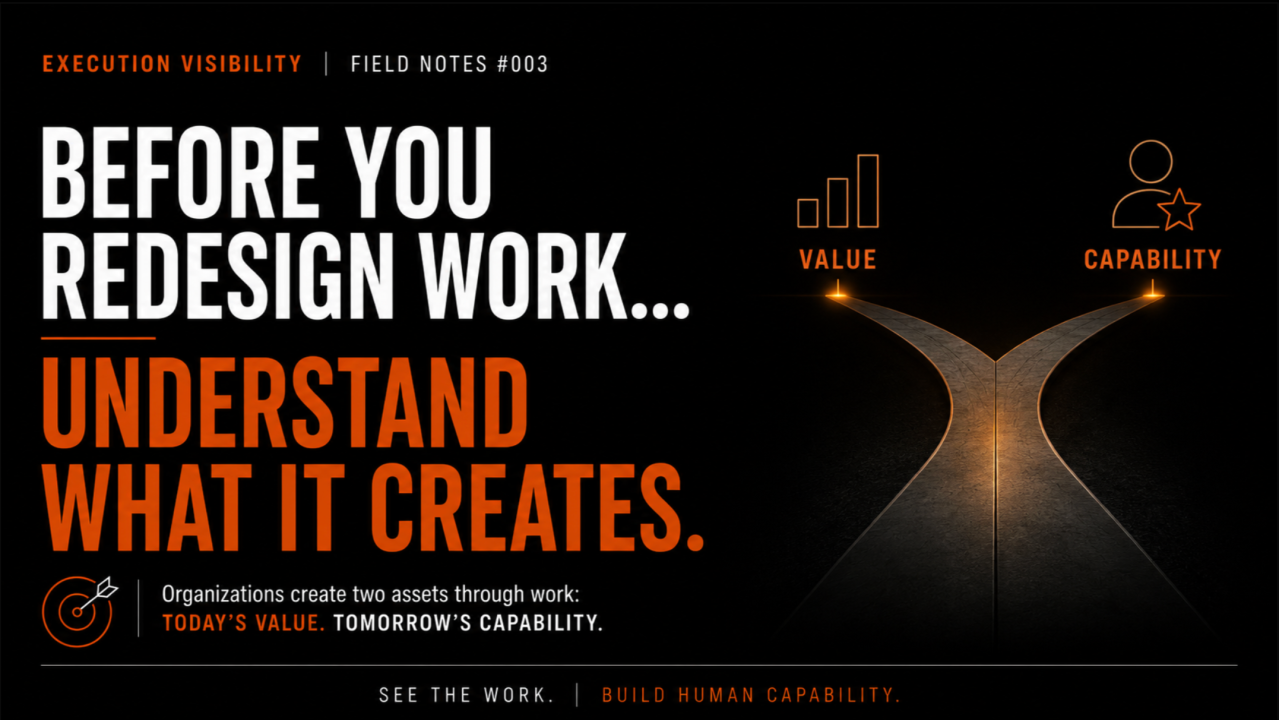
Organizations are racing to redesign work with AI. But before deciding what AI should do, leaders need to understand what work actually creates.
Field Note from Kason
Since publishing Field Notes #002, I’ve had the opportunity to speak with researchers, executives, founders, practitioners, and learning leaders exploring AI from very different perspectives.
Some were focused on workflow redesign. Others on organizational design. Others on skills, learning, or capability.
Although the conversations came from different disciplines, they all converged on one realization.
We’re no longer redesigning jobs. We’re redesigning work.
The question now is whether we understand that work well enough to redesign it wisely.
The Pattern I Couldn’t Ignore
Every conversation this week reinforced the same shift. For decades, organizations have designed around jobs.
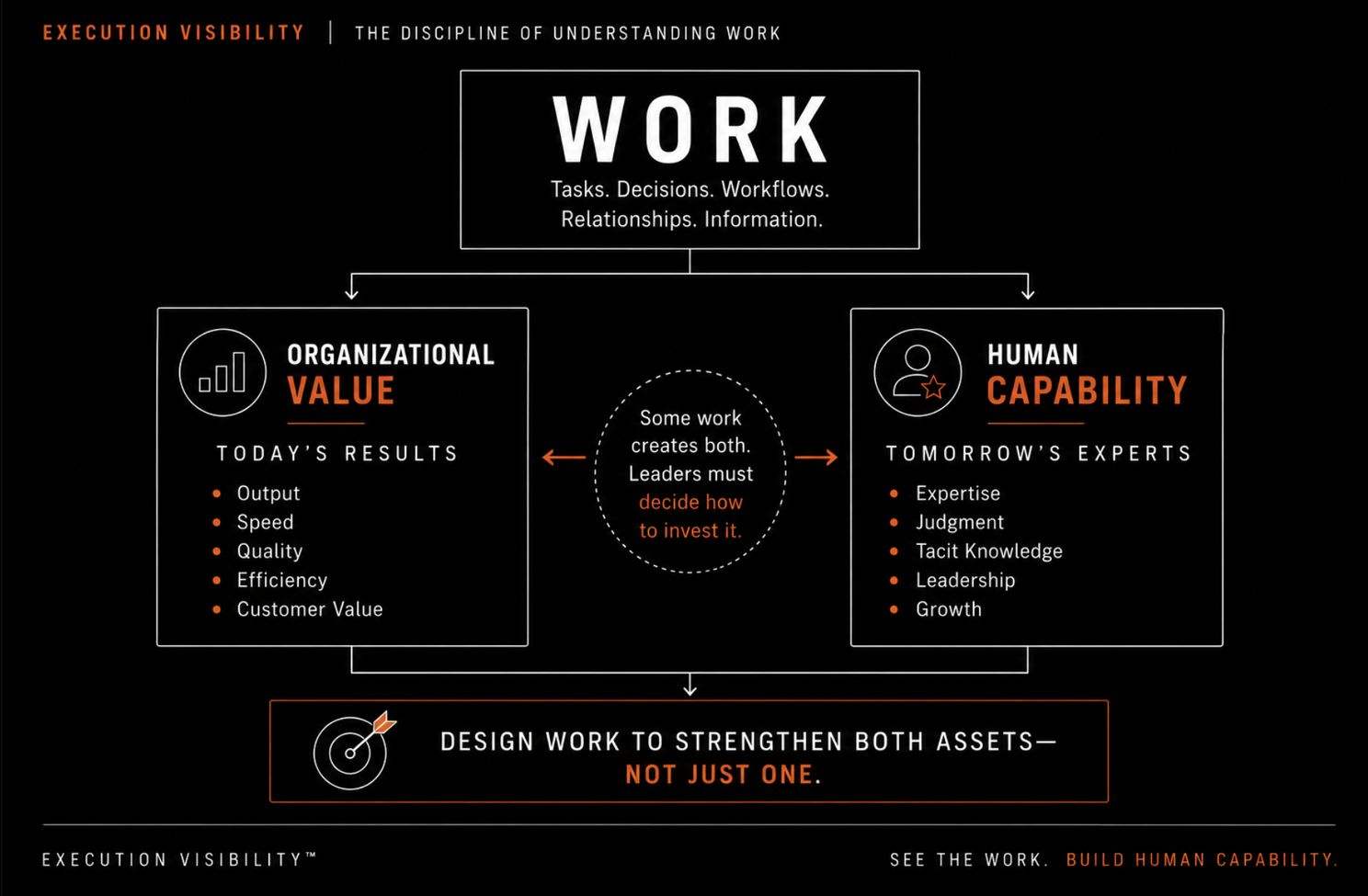
AI doesn’t. AI operates at the level of tasks, decisions, workflows, relationships, and information.
That changes everything. The conversation can no longer simply be: which jobs will AI replace?
The conversation has to become: which work should AI perform?
That’s progress. But I believe we’re still missing one critical question.
What does that work create?
Work Creates Two Assets
Organizations often think work exists to produce results. It does. But that’s only half the story.
Every meaningful piece of work creates two assets simultaneously: value for the organization, and capability for the people doing it.
One is visible. The other usually isn’t.
When someone leads a difficult customer conversation, the organization serves the customer. The employee develops judgment.
When a project manager recovers a failing project, the business delivers the project. The project manager learns how to lead under pressure.
When a physician diagnoses a difficult case, the patient receives treatment. The physician develops pattern recognition that will improve every diagnosis that follows.
The same work creates two very different outcomes. One is measured. The other compounds.
The Hidden Capability Factory
This is the idea I keep coming back to. Organizations don’t just produce products. They produce people.
Work is the factory where capability is built.
Every difficult conversation. Every unexpected problem. Every ambiguous decision. Every moment of coaching. Those experiences quietly create:
- Judgment
- Confidence
- Expertise
- Leadership
Those capabilities rarely appear on a dashboard. Yet they may become the organization’s greatest competitive advantage.
Work is where people become.
I no longer think that’s simply a philosophy. I think it’s becoming a design principle.
The Hidden Risk
Organizations are accelerating AI adoption. The technology is improving. Adoption is increasing. The productivity gains are real. But productivity isn’t the same as capability.
Imagine two analysts. One builds a presentation from scratch. The other asks AI to generate the first draft in thirty seconds.
The second analyst is unquestionably more efficient. But if AI also removes the need to structure the argument, recognize patterns, challenge assumptions, and defend recommendations… who is developing stronger judgment?
Efficiency improved. Capability may not have. That’s the leadership dilemma.
This Is Why Execution Visibility Matters
Execution Visibility is not another AI framework. It is the needed discipline of understanding how work creates value, how work builds capability, and how work develops human judgment.
Only then can leaders responsibly answer questions like:
- Which work should AI perform?
- Which work should remain intentionally human?
- Which work should be redesigned?
- Which work should be protected because it develops future capability?
Those are leadership decisions. Not technology decisions.
A New Leadership Responsibility
Over the past several months, I’ve become increasingly convinced of something. Organizations won’t compete because they adopted AI first. They’ll compete because they understood their work better.
The companies that win won’t simply automate faster. They’ll know which work creates value, which work creates capability, and which work creates the human judgment that technology cannot replace.
That may become one of the defining leadership disciplines of the AI era.
Closing Reflection
Every generation of leaders inherits a defining management challenge. Industrial leaders learned to manage production. Knowledge leaders learned to manage information.
AI leaders will need to learn something different. They will need to understand work itself.
Because before we redesign work, we have to understand what it creates.
Originally posted on LinkedIn.