Execution Visibility | Field Notes #004
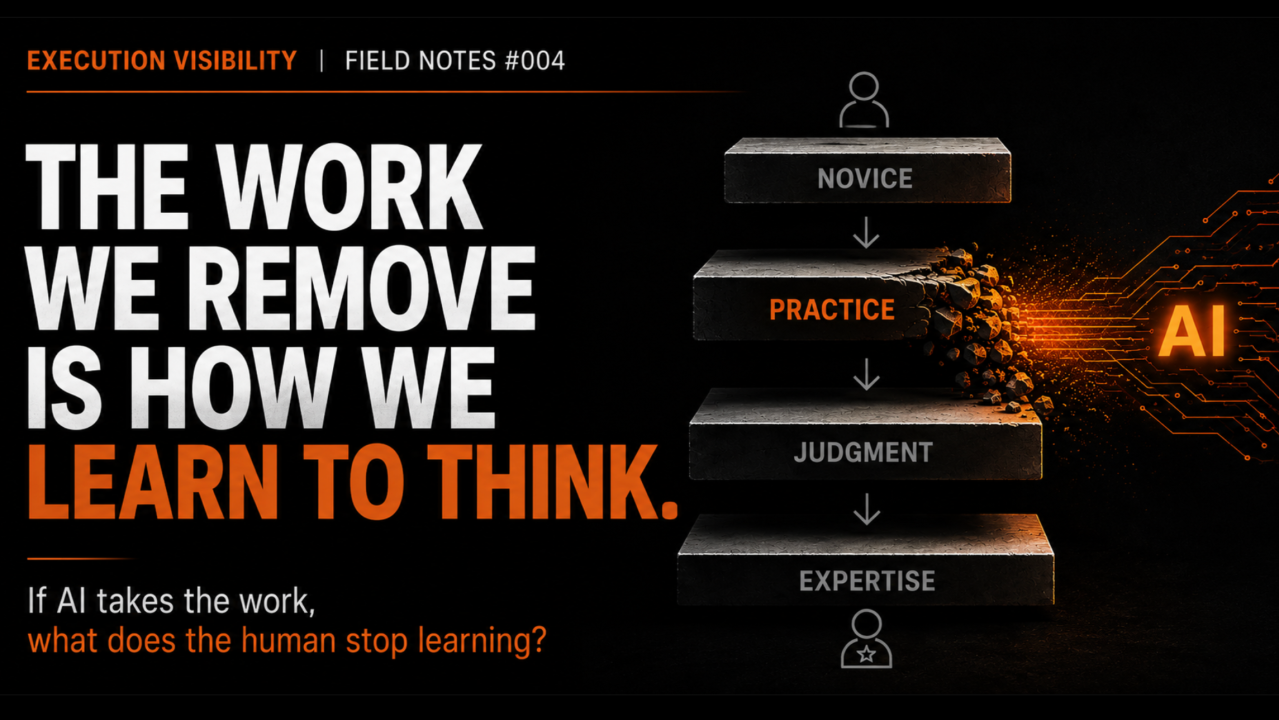
The Work We Remove Is How We Learn to Think
August 26, 2026
Over the past couple of weeks since my last field note, I’ve been thinking about how I learned to do my own work.
No single program taught me how to sit with an executive and challenge an assumption. Or recognize when a capability problem was really a work-design problem. Or know when the data wasn’t telling the whole story.
Most of that came from doing the work.
Getting things wrong. Watching people who were better than me. Being asked questions I couldn’t answer yet. Having my thinking challenged. Then doing it again.
When I look back across my career, a lot of the work that built my judgment probably didn’t look particularly valuable on its own.
But those experiences accumulated.
They were the work. And they were also the practice.
I’m not sure we’re making that distinction clearly enough as we redesign work around AI.
We’re getting very good at removing work
I came across an argument last week about something happening inside consulting.
The largest firms are putting hundreds of thousands of employees onto many of the same AI platforms and building increasingly similar approaches around them.
The author’s argument was about sameness: if firms use the same models, similar frameworks, and similar processes, how differentiated will the work eventually be?
Interesting question. But another question bothered me more.
Consulting has historically operated as a pyramid.
Junior people research. They analyze. They build models. They prepare first drafts. They sit through reviews. They watch senior people tear apart an argument and put it back together.
A lot of that work is exactly the kind of work AI is getting very good at doing.
From a productivity standpoint, that sounds great. Faster research. Faster analysis. Fewer hours building decks. More leverage per person.
But what was all that junior work producing besides the deliverable?
Because somewhere in all of those repetitions, the analyst becomes the consultant. Eventually, some of them become the people whose judgment clients are actually paying for.
So if AI increasingly does the work at the bottom of that pyramid, I keep coming back to a different question:
Where does the judgment at the top come from ten years from now?
Some work produces more than output
This is a thread I’ve been pulling on for a while. We tend to evaluate work by what it produces today.
- The report.
- The analysis.
- The customer response.
- The recommendation.
- The decision.
But work can produce another asset at the same time: capability.
A junior employee struggles through an analysis and starts recognizing patterns.
A manager handles a difficult conversation and gets better at reading what isn’t being said.
Someone makes a judgment call, gets it wrong, receives feedback, and carries that experience into the next decision.
Those things are difficult to see on a process map. They’re also difficult to put into an ROI calculation.
But that doesn’t make them incidental. They are part of how organizations produce expertise.
This is why some of the emerging research around AI and early-career work has caught my attention. Researchers have begun raising what is essentially a first-rung problem: when AI absorbs work traditionally performed by people earlier in their careers, it may also remove some of the experiences through which professional capability develops.
I think that deserves more attention. Not because we should preserve junior work for the sake of preserving junior work. Some of it should disappear.
But we need to get much better at distinguishing low-value work from developmental work. They aren’t always the same thing.
Human in the loop isn’t enough
There’s another assumption I’m starting to question. We talk a lot about keeping humans “in the loop.”
That makes sense when we’re thinking about oversight, risk, and accountability. But human presence tells us very little about human practice.
Imagine AI researches the problem, synthesizes the information, identifies patterns, generates options, and recommends an answer. A human reviews it and clicks approve.
Technically, a human was in the loop. But what did that person actually have to think through?
That’s becoming an important distinction for me.
Human participation is not the same as human practice.
And I think there’s another distinction underneath it: access to judgment is not the same as ownership of judgment.
AI can give someone access to an extraordinary amount of expertise. They can produce an analysis they might not have been able to produce independently. They can draft an executive recommendation. They can ask the model to challenge their assumptions.
That can make the person substantially more capable in the moment. But:
- Can they recognize when the analysis is wrong?
- Can they explain why one recommendation fits this situation better than another?
- Can they make the call when the available evidence is incomplete?
- Can they still reason when the model doesn’t know the answer?
Those are different questions. And increasingly, I think organizations need to know the answers.
I don’t want to romanticize grunt work
There’s an easy mistake to make here. We could decide that because some tedious work helped previous generations develop expertise, everyone coming behind us needs to suffer through it too.
I don’t buy that. I have no interest in protecting inefficient processes just because that’s how we learned.
AI should remove work that doesn’t need to exist. It should make people faster. It should give people access to capabilities that previously took years to develop. It may even create entirely new ways of developing expertise that are better than the ones we have today.
But we can’t assume the replacement happens automatically.
- If AI takes the first draft, where does someone learn to structure the argument?
- If it performs the analysis, where do they learn to recognize the pattern?
- If it recommends the decision, where do they practice making the call?
- If it catches the mistake before the employee ever experiences it, where does the lesson come from?
I don’t think most organizations have answered those questions yet.
This is becoming part of how I think about Execution Visibility
I started developing Execution Visibility because I kept seeing organizations make increasingly consequential decisions about AI without enough visibility into the work underneath them.
- Where is value actually created?
- Where could AI create leverage?
- Where is capability being built?
- Where does human judgment matter?
The more I work on this, the more connected those questions become. Because before automating a task, we need to understand more than what the task produces. We need to understand what doing the task produces in the person.
That gives leaders another question to ask when evaluating work for AI:
If AI takes this work, what does the human stop learning?
Sometimes the answer will be: not much. Automate it.
But sometimes that task may contain repetitions, decisions, feedback or exposure that eventually produce expertise somewhere else in the organization. Then the answer isn’t necessarily “don’t automate.” It might be: if we remove the work, we need to redesign the practice.
And that may become one of the harder parts of AI-enabled work design. We aren’t just redesigning a production system. We’re redesigning a system that has been producing people, too.
I don’t think we fully understand what replaces all of those experiences yet. But we should probably figure that out before they’re gone.
The question isn’t whether AI can do the work. Increasingly, it can. The harder question is whether we understand what people were becoming while they did it.
Execution Visibility | Field Notes is a bi-weekly series about making work visible before redesigning it with AI. See the work. Build human capability.
Originally posted on LinkedIn.