Execution Visibility | Field Notes #005
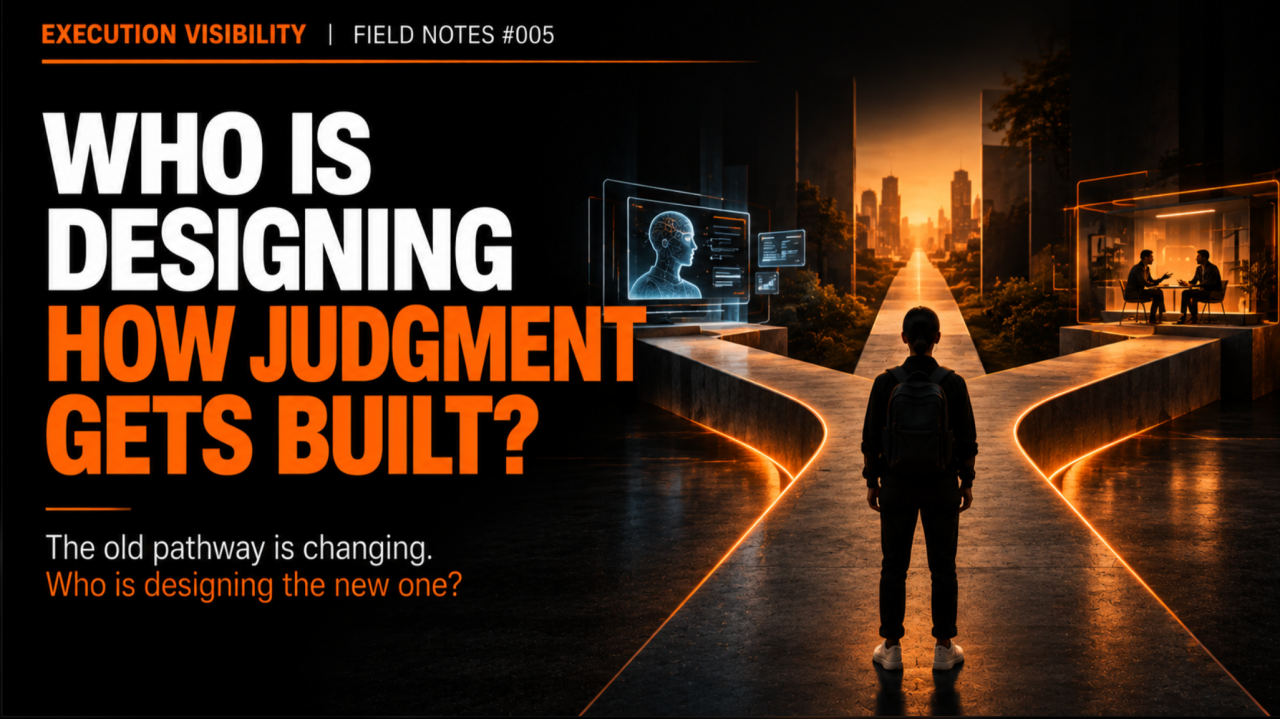
Who Is Designing How Judgment Gets Built?
September 28, 2026
I took a little time away over the last month.
Since coming back, I’ve had a number of conversations with leaders thinking about AI, work design, learning, talent, and organizational transformation from very different angles.
I’ve also been reading research on AI and early-career work, capability development, and how universities are thinking about preparing people for a world where machines can do more knowledge work.
Different conversations. Different contexts. But I keep coming back to the same question:
If human judgment is becoming more valuable, who is designing how people will build it?
I don’t think we’ve worked that out yet.
#1: Judgment has to come from somewhere
A lot of the AI conversation assumes a fairly straightforward division of labor. AI does more of the drafting, analysis, synthesis, and routine execution. People move toward higher-value work requiring context, creativity, relationships, and judgment.
I understand the logic. But there’s a developmental question underneath it. Where did the person’s judgment come from?
Think about the first analysis you got wrong and had to defend. The customer situation that didn’t fit the playbook. The recommendation someone more experienced challenged. The meeting where you misread the room. The project where you made the call, lived with the consequences, and understood something afterward that you couldn’t have learned from reading about it.
Those experiences produced work. They were also producing you.
Pattern recognition. Context. Confidence. Judgment. Eventually, expertise.
That’s the part I think organizations and leaders need to understand much better as we redesign work around AI.
#2: The tension is getting harder to ignore
A new Cornell report on the future of the American university helped sharpen this for me.
Cornell’s committee makes sound judgment one of education’s central outcomes. They argue that judgment develops through difficult problems, uncertainty, mistakes, feedback, relationships, and repeated practice. They also identify a tension that extends well beyond education.
Using AI well requires judgment. You need to know what to ask, recognize when an answer is wrong, understand what’s missing, and decide when AI shouldn’t be used at all. But overreliance on AI can also bypass some of the experiences through which that judgment develops.
That’s the paradox. AI can amplify judgment once it exists.
The harder question is how judgment develops in the first place. And this isn’t only showing up in education. Recent research on early-career work is raising questions about what happens when AI changes the entry-level tasks through which people have historically gained experience.
I’ve heard the same concern in conversations with executives, practitioners, and people building AI-enabled products. We are getting much better at asking what AI can do. I’m not sure we’re equally good yet at asking what people were becoming capable of by doing the work AI may now do for them.
#3 This doesn’t mean preserving old pathways
This is where my thinking has evolved. My argument isn’t that we should preserve inefficient work because people once learned from it. That would be a terrible reason to keep bad work. And one of the more useful challenges I’ve heard recently is that AI itself may become part of the solution.
Simulation can give someone opportunities to practice a difficult conversation before having it. AI can create scenarios, introduce exceptions, challenge a recommendation, and provide immediate feedback. In some cases, we may be able to create more practice than the old model provided.
I think that’s important. But it also means we need to get more precise about what we’re trying to develop.
A simulation can create repetition. It can create practice. It can allow someone to fail safely and try again.
But practice and experience aren’t always the same thing.
Some judgment develops precisely because the situation isn’t simulated. Someone else is depending on the decision. The information is incomplete. There are relationships involved. You have to defend your recommendation. You’re accountable for what happens next. And sometimes you don’t know whether you made the right decision until much later.
That suggests a more useful question than whether AI can replace the old developmental experience:
Which capabilities can we build through AI-supported practice, and which still require exposure to the real work?
#4 We may need to design the reps
This is where I think the management challenge changes. If AI removes an experience that helped someone develop judgment, we don’t necessarily need to recreate that experience. We need to understand what developmental function it served.
Maybe the answer is simulation. Maybe it’s apprenticeship. Maybe it’s earlier exposure to customers. Maybe it’s rotations, stretch assignments, harder decisions, structured feedback, or giving someone ownership sooner. Maybe AI allows us to remove ten low-value repetitions while deliberately designing three much better ones.
I don’t think there’s one answer. But leaving it to chance feels increasingly risky.
Cornell’s response is instructive here. The report doesn’t argue for protecting education from AI or returning to the way students learned before it existed. It argues for becoming more intentional about the experiences through which judgment is cultivated.
For organizations, I think the same principle applies.
The objective isn’t to preserve the old pathway. It’s to intentionally design the new one.
#5 I think this changes what we need to see
This is also why I’ve continued developing the idea of Execution Visibility. Before redesigning work, leaders need to understand more than the output a task produces.
Some work creates today’s results. Some of that same work also creates tomorrow’s capability.
If we only see the output, an automation decision can look obvious.
But if we can also see where judgment is being exercised, where expertise is forming, and which experiences are developing people, we can make a different quality of decision about what to automate, augment, or redesign.
That’s Capability Visibility.
And increasingly, I think it needs to sit alongside the productivity conversation. Because “human in the loop” doesn’t answer the developmental question. A person can review an AI-generated recommendation without developing the capability to produce or challenge that recommendation independently.
Human participation does not automatically create human practice.
The question I’m leaving with
We’ve spent a lot of time asking how work changes when AI can do more of it. I think the next question is harder.
If the work that remains requires more judgment, how will people become capable of exercising it?
Some of the old developmental pathways will disappear. Some should disappear.
AI will help us create new ones. But someone has to design them.
And I’m increasingly convinced that this can’t sit only with Learning, Talent or HR. It belongs in the same conversation where leaders are making decisions about AI, operating models, and redesigning work itself.
Because every automation decision is also a capability decision.
And if judgment really is becoming more valuable, we should probably know how our organizations produce it.
Who is designing that in yours?
Execution Visibility | Field Notes is a series about making work visible before redesigning it with AI. See the work. Build human capability.
Originally posted on LinkedIn.